---
title: "Hydration on the world stage: what the 2026 World Cup started"
description: The 2026 World Cup put a hydration break in all 104 matches. What it revealed about heat, physiology and performance, on the pitch and on the job site.
image: https://marketing.epicorebiosystems.com/hubfs/From%20the%20Neck%20Up%20Why%20Hard%20Hats%20and%20Heat%20Rules%20Share%20the%20Same%20Blind%20Spot%20(1).jpg
---
[Skip to content](https://marketing.epicorebiosystems.com/epicore-biosystems-blog/hydration-on-the-world-stage-what-the-2026-world-cup-started#main-content)
[.png?width=500&height=200&name=Untitled%20design%20(26).png)Homepage](https://www.epicorebiosystems.com/)
- [Products](https://www.epicorebiosystems.com/our-solutions/connected-hydration/)
- [Research](https://www.epicorebiosystems.com/research/)
- [Publications](https://www.epicorebiosystems.com/publications/)
- [About Us](https://www.epicorebiosystems.com/about/)
- [Media](https://www.epicorebiosystems.com/news-press/)
[Get started](https://www.epicorebiosystems.com/)
- [Products](https://www.epicorebiosystems.com/our-solutions/connected-hydration/)
- [Research](https://www.epicorebiosystems.com/research/)
- [Publications](https://www.epicorebiosystems.com/publications/)
- [About Us](https://www.epicorebiosystems.com/about/)
- [Media](https://www.epicorebiosystems.com/news-press/)
[Get started](https://www.epicorebiosystems.com/)
.jpg?width=1200&height=630&name=From%20the%20Neck%20Up%20Why%20Hard%20Hats%20and%20Heat%20Rules%20Share%20the%20Same%20Blind%20Spot%20(1).jpg)
Sports
# Hydration on the world stage: what the 2026 World Cup started

Navroop Sidhu
August 31, 2026
### A three-minute pause made 5 billion people think about hydration. The conversation it started matters far beyond football.
Every World Cup gives the world a new reason to watch. This one gave it a strange one: twice a match, in all 104 games, the referee stopped play so that everyone could drink.
The world’s eyes were on this tournament for plenty of familiar reasons. But the [mandatory three-minute hydration break](https://fortune.com/2026/03/09/world-cup-hydration-breaks-tv-ads-revenue-fifa-global-viewership/), fixed at the 22nd minute of each half regardless of the weather, was genuinely new. Nothing like it existed in the previous 95 years of World Cups.
There are two honest readings of why it happened, and they’re both true. This post takes the tournament at face value: what those pauses revealed about heat, human physiology and performance, the technology that showed up to manage both, and why this conversation has to keep going in a world that keeps getting hotter, long after the trophy tour ends.
### **Part one: the pause that made everyone look**
#### A break with two purposes
The physiological case was real. Only [3 of the 16 venues had air conditioning](https://www.sportsbusinessjournal.com/Articles/2026/07/02/heat-hydration-prep-and-tech-now-critical-during-the-world-cup-of-the-sports-scientist/), and World Weather Attribution projected that [26 of the 104 matches](https://www.goal.com/en-us/lists/fifa-world-cup-water-bottle-ban-u-turn-backlash/blte79dcb83bd29f191) would be played above 26°C wet-bulb globe temperature. WBGT is a stricter measure than the number on a thermometer: it blends humidity, radiant heat from the sun, wind and air temperature into a single reading, weighted most heavily toward humidity, which is why a 26°C WBGT afternoon is far more punishing than 26°C in the shade. That’s the level at which heat [researchers at UConn’s Korey Stringer Institute](https://today.uconn.edu/2026/06/uconn-experts-push-fifa-to-protect-players-from-extreme-heat/) urged FIFA to trigger protective measures, pushing for six-minute breaks and air-conditioned locker rooms, and the level [BBC Sport flagged](https://www.bbc.com/sport/football/articles/cy928q8engzo) in its own heat coverage. FIFA’s own medical guidelines had previously reserved cooling breaks for WBGT readings above 32°C. Detaching the break from the thermometer and fixing it to the clock treated heat as a permanent feature of a North American summer tournament rather than a bad-day contingency.
The commercial case was also real. Broadcasters were allowed to sell advertising inside the breaks, creating [832 commercial slots](https://gowlingwlg.com/en/insights-resources/articles/2026/fifa-hydration-breaks-in-the-world-cup) in a sport that never had in-game inventory. Gowling WLG’s analysis put Fox Sports’ hydration-break ad revenue near $250 million for the tournament, with 30-second slots in the final reportedly fetching [$8 million](https://gowlingwlg.com/en/insights-resources/articles/2026/fifa-hydration-breaks-in-the-world-cup), against roughly [$1 million in the 2022 final](https://fortune.com/2026/03/09/world-cup-hydration-breaks-tv-ads-revenue-fifa-global-viewership/). Fans felt the commercial edge too: FIFA briefly [banned reusable water bottles](https://www.goal.com/en-us/lists/fifa-world-cup-water-bottle-ban-u-turn-backlash/blte79dcb83bd29f191) from stadiums four days before kickoff, then reversed within four days after supporters’ groups and the UK Prime Minister called it out.
So yes, the break was an ad window, and Gowling concluded the revenue makes it effectively irreversible. The genie is out of the bottle. If this has changed the world’s biggest sporting event forever, the bigger question is this: who will gain an edge and get the most out of it?
#### **Three minutes, if you know what to do with them**
Portugal manager Roberto Martinez answered that within days: “[In technical terms this changes how we work, we’re talking about three minutes where we can make adjustments.](https://gowlingwlg.com/en/insights-resources/articles/2026/fifa-hydration-breaks-in-the-world-cup)” Coaches treated the break as tactical time from the first match.
The physiological version of that opportunity is bigger, and it starts with a number. Scientists widely report measurable performance decline once fluid loss passes [2% of body weight](https://www.epicorebiosystems.com/publications/): high-intensity sprinting drops, and so does skill execution like dribbling. In tournament heat, a soccer player can sweat out 1.3 litres or more per hour. And thirst doesn’t announce itself until you’re already 1 to 2% down, so by the time a player wants the bottle, the deficit is already at work.
But the biggest variable is individual physiology. Research from the Gatorade Sports Science Institute, [cited by our co-founder and CEO Rooz Ghaffari in Forbes](https://www.forbes.com/councils/forbestechcouncil/2026/07/22/beyond-world-cup-hydration-breaks-the-growing-threat-of-extreme-heat/), puts the spread in sweat rates at up to twentyfold between individuals in identical conditions. [GSSI measured 1,303 athletes to build its reference data](https://www.gssiweb.org/en/research/Article/normative-data-for-sweating-rate-sweat-sodium-concentration-and-sweat-sodium-loss-in-athletes-an-update-and-analysis-by-sport), and the picture for soccer is simple: the typical player loses about a litre of sweat an hour, but line up any two teammates and one can easily be losing two or three times the fluid, and several times the salt, of the other. The differences inside one dressing room are bigger than the differences between sports. Everyone sweats differently, and it only takes one player crossing that line, one dulled sprint or one slow decision in the 85th minute, to cost the team the game.
Rooz put the implication plainly in that Forbes piece: “A three-minute break isn’t a hydration strategy. It’s an opportunity.” Handing 11 different physiologies the same bottle at minute 22 uses the pause. Knowing what each body is losing fills it.
#### **The technology that showed up**
The tournament doubled as a showcase for a whole category of heat and recovery technology, and it went well beyond drinks.
Cooling. Adidas fitted teams with gel-filled cooling vests for halftime and pre-match use. [Therabody launched the CryoTherm Palm](https://athletechnews.com/therabody-launches-thermoregulation-device-cryothermpalm-ahead-of-world-cup/) in June, a handheld palm-cooling device that England integrated into training and sideline protocols, built for exactly the intervals the new rule created: timeouts, halftime, and water breaks.
Readiness and recovery wearables. [Oura became the official wearable of U.S. Soccer](https://athletechnews.com/fifa-world-cup-wellness-brands-oura-whoop-hyperice-therabody/) and signed England’s Harry Kane and Declan Rice as ambassadors on opening day. Jude Bellingham was photographed in a Whoop band at England training. Hyperice supplied recovery technology across the U.S. programme.
The Gatorade Gx Sweat Patch (below)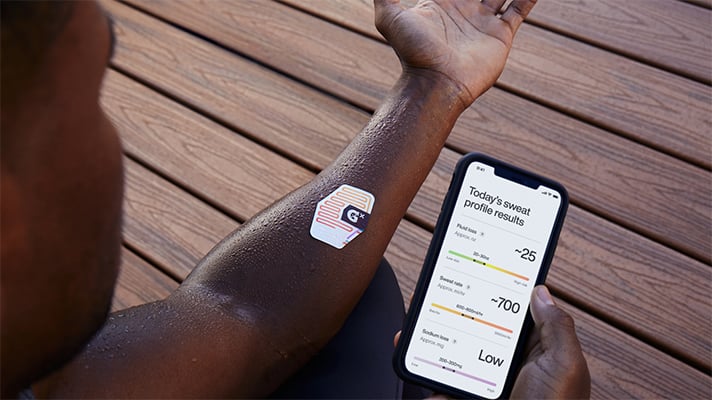
Hydration monitoring. Brazil has worked with Gatorade for over a decade, and ahead of this World Cup the Gatorade Sports Science Institute [built individual sweat-rate and electrolyte-loss profiles for every player](https://www.cnn.com/2026/07/05/health/world-cup-teams-fitness-trackers-wellness), then deployed the [Gx Sweat Patch](https://www.epicorebiosystems.com/our-solutions/gx-sweat-patch/), the wearable we developed with Gatorade, to track fluid and sodium losses in real time. [Sportico reported](https://www.sportico.com/leagues/soccer/2026/world-cup-heat-forecast-temperatures-hydration-breaks-rules-1234937506/) that those profiles feed personalized hydration formulas for each player. As Rooz told [Sports Business Journal](https://www.sportsbusinessjournal.com/Articles/2026/07/02/heat-hydration-prep-and-tech-now-critical-during-the-world-cup-of-the-sports-scientist/), the value is longitudinal: you have to know how an athlete responds over time, down to where he spent his club season, to anticipate what he’ll need.
These tools solve different problems, and the difference comes down to what you can act on in the moment. A readiness score describes how your body responded to yesterday, and there’s not much to do with that at 2pm: if you slept badly, you can’t sleep again before the second half. Cooling helps once heat has already built up. Body fluid monitoring is the piece that’s actionable in real time, because the fluid you’re losing carries the information you need to respond. Know that you’ve lost two litres more than usual on a brutally hot day, and that you lose more salt than most, and you know exactly what and how much to put back before performance slips. That’s why Brazil’s approach stood out: the profiles were built years before the first whistle, so when the referee signalled the break, every player already knew what his body needed.
### **Part two: the conversation can’t end with the tournament**
#### **Heat is reshaping sport everywhere, and faster**
The World Cup was the loudest example of something happening across sport. As heat researcher Professor Ollie Jay put it, “[extreme heat has been reshaping sport for years](https://heathealth.info/news/extreme-heat-a-new-red-card-for-sports/)”, and the [World Meteorological Organization](https://heathealth.info/news/extreme-heat-a-new-red-card-for-sports/) expects global temperatures to hold at or near record levels for the next five years.
The adaptations are piling up. The Australian Open built a five-level Heat Stress Scale after players collapsed in 2014 and 2018. Australia’s National Rugby League extended halftime using sport-specific heat tools. Tokyo moved Olympic equestrian events to the evening.
Formula 1 offers the sharpest preview of where this goes. After the 2023 Qatar Grand Prix, where [one driver retired from heat and another nearly lost consciousness at speed](https://www.espn.com/f1/story/_/id/46474976/singapore-heat-hazard-how-f1-cooling-vests-work), the FIA created a formal “heat hazard” designation. It was declared for the first time at Singapore 2025: cockpits approaching 60°C, drivers losing around 3 kilograms, roughly 3 litres of fluid, in a two-hour race. That’s 4 to 5% of body weight, more than double the threshold where performance degrades, in a sport where the athlete is making 300 km/h decisions. The FIA’s answer was mandated readiness for liquid-cooled vests, with a weight allowance so no team is penalized for protecting its driver.
Notice the pattern. In football, in tennis, in rugby league, in motorsport: a heat crisis, then a rule, then technology to fill the gap the rule can’t.
#### **The biggest team plays outside**
Here’s the part that outlasts every tournament: the same physiology governs the roughly [2.4 billion people the WHO says work in heat-exposed jobs](https://library.wmo.int/records/item/57200-climate-change-and-workplace-heat-stress). A footballer sweats through 90 minutes. A utility worker, a roughneck or a ground crew works 8 to 12 hours, and can lose [12 litres or more in a shift](https://library.wmo.int/records/item/57200-climate-change-and-workplace-heat-stress). One field study found [70% of workers arrived or ended their day hypohydrated](https://pubmed.ncbi.nlm.nih.gov/29444748/), at levels corresponding to roughly the same 2% body-mass loss that costs a striker his sprint.
Regulators have noticed, on the same timeline as FIFA. [OSHA’s renewed National Emphasis Program on heat](https://ogletree.com/insights-resources/blog-posts/world-cup-2026s-hydration-breaks-highlight-employers-duties-to-prevent-heat-hazards/) took effect in April 2026, covering 55 high-risk industries, with “heat priority days” triggering at a heat index of 80°F. And the official injury numbers badly understate the problem. The National Safety Council reports that [exposure to environmental heat caused 48 work-related deaths in 2024 and 7,100 injury cases involving days away, restricted duty or transfer across 2023 and 2024](https://injuryfacts.nsc.org/work/safety-topics/exposure-to-environmental-heat/). Set that against a 2025 nationwide analysis in Environmental Health estimating roughly 28,000 heat-attributable workplace injuries in the U.S. in a single year. The gap between those numbers is the undercount: official surveys miss injuries by 20 to 60% generally, heat-specific cases have run[three to six times higher in workers’ compensation data](https://link.springer.com/article/10.1186/s12940-025-01231-1) than in federal statistics, and OSHA itself applied a 7.5x underreporting factor in its proposed heat rule. The recorded numbers are the visible tip. An employment law firm has already published a client advisory that [used the World Cup’s hydration breaks as its opening argument](https://ogletree.com/insights-resources/blog-posts/world-cup-2026s-hydration-breaks-highlight-employers-duties-to-prevent-heat-hazards/) for employer duties. The crossover is happening.
For safety leaders, the lesson from the tournament sorts into three problems that “water, rest, shade” alone can’t solve. We’ve written before about [how hard hats and heat rules share the same blind spot](https://marketing.epicorebiosystems.com/epicore-biosystems-blog/hard-hats-heat-rules-share-the-same-blind-spot): both document that protection was offered without measuring whether the person was actually protected.
Cognition. The brain is the first organ affected by dehydration, and it doesn’t announce itself. Heat and fluid loss erode the complex functions first: sustained attention, working memory, decision-making and inhibitory control, the exact faculties behind hazard recognition, situational awareness and operating heavy equipment. The dose-response is well characterized: at roughly 2% body-mass loss, reaction time, short-term memory and vigilance measurably decline. At 3%, errors roughly double, with impairment that driving research has compared to operating at the legal alcohol limit. Everything below the visible-distress threshold is where incidents actually happen, and it’s exactly the band no conventional program monitors, which is why we’ve called [cognition the missing metric in occupational heat safety.](https://marketing.epicorebiosystems.com/epicore-biosystems-blog/missing-metric-part-1-cognition-occupational-heat-safety)
Capacity. Workers don’t arrive in a uniform state. Yesterday’s fluid loss, sleep, acclimatization and medications all shape today’s starting point, and our own field data shows the same individual can vary up to 10x in sweat loss across different days. Averaged break schedules produce averaged outcomes: some workers protected, some not.
Compliance. “Drink before you’re thirsty” is an instruction, not a measurement. Thirst is a lagging indicator that activates [after the deficit already exists](https://pubmed.ncbi.nlm.nih.gov/22855911/), and most safety programs today can confirm a hydration policy exists without being able to confirm it works. An instruction that’s never verified isn’t a control. This protection already exists for industrial workers as [Connected Hydration](https://www.epicorebiosystems.com/our-solutions/connected-hydration/), which we built specifically for the industrial use case: it computes each worker’s personal 2% threshold from their own body, vibrates at every 500 mL of fluid loss well before thirst registers, and latches its alarm at 2% the way a gas detector holds an LEL alert, so the worker acts before anyone feels bad.
That’s the real export from this World Cup. Planned drinking before, during and after. Individual profiles instead of averages. Cues that arrive ahead of symptoms. None of it requires a stadium.
#### **Keeping the conversation going**
FIFA’s three-minute pause will be remembered as the moment hydration became part of the rules of the world’s biggest game, whatever mix of physiology and television money got it there. Five billion people watched sport stop for water, twice a match, for six weeks.
The heat that forced the issue isn’t going anywhere, and the next tests are already scheduled: more summer tournaments, more heat-hazard races, more August camps, and hundreds of millions of shifts worked outdoors every day in between. The organizations that get ahead of it will be the ones that treat those pauses the way Brazil did, backed by years of individual data, rather than as three minutes of guessing.
The world just spent a summer thinking about hydration. The advantage goes to whoever keeps thinking about it.
If you have elite, industrial or everyday athletes who perform in the heat, there are wearables to help improve their performance and keep them safe.
### FAQs
1. What is wet-bulb globe temperature (WBGT)?
WBGT is a heat stress index combining four factors: air temperature, humidity, wind and radiant heat from the sun. Outdoors it’s calculated as a weighted blend, with roughly 70% of the score coming from the wet-bulb reading that captures humidity, 20% from radiant heat and 10% from air temperature. It’s the measure preferred by sports and occupational medicine bodies because it captures how hard it actually is for a body to shed heat.
2. How is WBGT different from the temperature in my weather app?
Your weather app reports air temperature measured in the shade, sometimes with a heat index that adjusts for humidity. Both assume a typical person at rest, in shade, in light wind. WBGT adds radiant heat and wind, which is why a reading taken in direct sun on an open pitch can describe a much harsher environment than the number on your phone.
3. Why did FIFA use WBGT for its old cooling-break rule?
Because air temperature alone under-predicts risk during exercise. FIFA’s medical guidelines triggered cooling breaks above 32°C WBGT. The 2026 rule went further by making breaks universal regardless of conditions, while researchers at the Korey Stringer Institute have urged FIFA to treat 26°C WBGT as the trigger for stronger protections.
4. What does 2% body mass loss mean in practice?
It’s the fluid-deficit threshold where measurable performance decline begins. For a 73 kg player it’s about 1.5 litres of net loss; for an 80 kg athlete, about 1.6 litres. Endurance, sprint quality and skill execution all suffer beyond it, and heat illness risk rises.
5. Why isn’t drinking when thirsty enough?
Thirst typically doesn’t register until you’ve already lost 1 to 2% of body mass, which overlaps the zone where impairment starts. It’s a lagging indicator, useful but late.
6. Do hydration needs really differ that much between people?
Yes. GSSI research puts the spread in sweat rates at up to twentyfold between individuals in the same conditions, and salt concentration varies several-fold on top. The same person can also vary from day to day, which is why single tests age poorly and continuous or repeated measurement matters.
## Share this post
[mailto:https%3A%2F%2Fmarketing.epicorebiosystems.com%2Fepicore-biosystems-blog%2Fhydration-on-the-world-stage-what-the-2026-world-cup-started](mailto:https%3A%2F%2Fmarketing.epicorebiosystems.com%2Fepicore-biosystems-blog%2Fhydration-on-the-world-stage-what-the-2026-world-cup-started)
## Keep reading
### [ Industrial The Missing Metric, Part 1: The Question We Never Asked](https://marketing.epicorebiosystems.com/epicore-biosystems-blog/missing-metric-part-1-cognition-occupational-heat-safety)
### [ Industrial Hard Hats and Heat Rules: The Same Safety Blind Spot](https://marketing.epicorebiosystems.com/epicore-biosystems-blog/hard-hats-heat-rules-share-the-same-blind-spot)
[.png?width=500&height=200&name=Untitled%20design%20(26).png "Epicore logo with blue droplet")](http://www.epicorebiosystems.com)
- Home
- Products
- Pricing
- Blog
- Company
---
[Privacy Policy](https://www.epicorebiosystems.com/privacy/) · [Terms and Conditions](https://www.epicorebiosystems.com/terms-conditions/) · © 2026. All rights reserved.
```json
{
"@context" : "https://schema.org",
"@type" : "BlogPosting",
"author" : {
"@type" : "Person",
"name" : "Navroop Sidhu",
"url" : "https://marketing.epicorebiosystems.com/epicore-biosystems-blog/author/navroop-sidhu"
},
"dateModified" : "2026-08-31T23:12:05.463Z",
"datePublished" : "2026-08-31T23:12:05.000Z",
"headline" : "Hydration on the world stage: what the 2026 World Cup started",
"image" : [ "https://marketing.epicorebiosystems.com/hubfs/From%20the%20Neck%20Up%20Why%20Hard%20Hats%20and%20Heat%20Rules%20Share%20the%20Same%20Blind%20Spot%20(1).jpg" ],
"mainEntityOfPage" : {
"@id" : "https://marketing.epicorebiosystems.com/epicore-biosystems-blog/hydration-on-the-world-stage-what-the-2026-world-cup-started",
"@type" : "WebPage"
},
"publisher" : {
"@type" : "Organization",
"logo" : {
"@type" : "ImageObject",
"url" : "https://marketing.epicorebiosystems.com/hubfs/Untitled%20design%20(26).png"
}
}
}
```
```json
{
"@context" : "https://schema.org",
"@type" : "FAQPage",
"mainEntity" : [ {
"@type" : "Question",
"acceptedAnswer" : {
"@type" : "Answer",
"text" : "WBGT is a heat stress index combining four factors: air temperature, humidity, wind and radiant heat from the sun. Outdoors it is calculated as a weighted blend, with roughly 70% of the score coming from the wet-bulb reading that captures humidity, 20% from radiant heat and 10% from air temperature. It is the measure preferred by sports and occupational medicine bodies because it captures how hard it actually is for a body to shed heat."
},
"name" : "What is wet-bulb globe temperature (WBGT)?"
}, {
"@type" : "Question",
"acceptedAnswer" : {
"@type" : "Answer",
"text" : "Your weather app reports air temperature measured in the shade, sometimes with a heat index that adjusts for humidity. Both assume a typical person at rest, in shade, in light wind. WBGT adds radiant heat and wind, which is why a reading taken in direct sun on an open pitch can describe a much harsher environment than the number on your phone."
},
"name" : "How is WBGT different from the temperature in my weather app?"
}, {
"@type" : "Question",
"acceptedAnswer" : {
"@type" : "Answer",
"text" : "Because air temperature alone under-predicts risk during exercise. FIFA's medical guidelines triggered cooling breaks above 32 degrees Celsius WBGT. The 2026 rule went further by making breaks universal regardless of conditions, while researchers at the Korey Stringer Institute have urged FIFA to treat 26 degrees Celsius WBGT as the trigger for stronger protections."
},
"name" : "Why did FIFA use WBGT for its old cooling-break rule?"
}, {
"@type" : "Question",
"acceptedAnswer" : {
"@type" : "Answer",
"text" : "It is the fluid-deficit threshold where measurable performance decline begins. For a 73 kg player it is about 1.5 litres of net loss; for an 80 kg athlete, about 1.6 litres. Endurance, sprint quality and skill execution all suffer beyond it, and heat illness risk rises."
},
"name" : "What does 2% body mass loss mean in practice?"
}, {
"@type" : "Question",
"acceptedAnswer" : {
"@type" : "Answer",
"text" : "Thirst typically does not register until you have already lost 1 to 2% of body mass, which overlaps the zone where impairment starts. It is a lagging indicator, useful but late."
},
"name" : "Why isn't drinking when thirsty enough?"
}, {
"@type" : "Question",
"acceptedAnswer" : {
"@type" : "Answer",
"text" : "Yes. GSSI research puts the spread in sweat rates at up to twentyfold between individuals in the same conditions, and salt concentration varies several-fold on top. The same person can also vary from day to day, which is why single tests age poorly and continuous or repeated measurement matters."
},
"name" : "Do hydration needs really differ that much between people?"
} ]
}
```