.png?width=500&height=200&name=Untitled%20design%20(26).png)
Industrial

In April 2017, Clark Construction moved employees coast to coast from a Type 1 hard hat to a Type 2 helmet. More than 3,500 units. Seth Randall, the division safety director, gave a blunt reason: their old hard hats offered no protection against a fall. [5,6]
Clark did not wait for a mandate, because the mandate was not coming. And the reason it was not coming is the same reason heat plans stall today. Both a hard hat and a written heat plan are built around an assumption about how workers get hurt. When that assumption is incomplete, compliance still looks perfect.
Since 1919, the hard hat has done one job: stop an object falling onto the crown of the head. That was the hazard the shell was designed around, and the standard followed the design.
Then NIOSH looked at the outcomes. Studying fatal traumatic brain injuries in construction from 2003 to 2010, it found that TBIs accounted for 25 percent of all construction deaths, and that more than half of those came from falls rather than from falling objects. [1] Workers were dying from the mechanism the hard hat was never engineered to address. That finding was published, and Type 1 stayed the default.
Virginia Tech's Helmet Lab eventually put a number on the gap. Moving from a Type 1 hard hat to a Type 2 helmet cuts fall related concussion risk by an average of 34 percent and skull fracture risk by 65 percent. [2] Clark, Skanska, Clayco and Pepper Construction all switched without a rule telling them to. [4,6] OSHA did not put its own inspectors in Type 2 helmets until December 2023. [7] ANSI/ISEA Z89.1 is expected to finalize its next revision in the second quarter of 2026, and after a decade the headline change is a mandatory chin strap marking. [3]
Falls are still not named in the standard as the primary mechanism of fatal head injury in construction. The data has said otherwise for 20 years.
Water, rest and shade is the right answer. It has been the right answer since NIOSH published its first criteria for work in hot environments in 1972. [17] The problem is not the controls. The problem is what the plan quietly assumes about them.
A hard hat assumed the danger came from above. A heat plan assumes that a worker who was offered water drank enough of it, that a worker who took a break actually cooled down during it, and that shade was reached before the radiant load started to matter. A written plan records the offer. It does not record the outcome.
So water, rest and shade is the floor, not the program. Whether it is working on a given afternoon, for a given person, is a separate question, and almost nobody is asking it.
Two things sit outside every heat plan ever written, and both of them decide whether the plan worked.
Capacity is where individual variation lives. A 45 year old on his third double shift does not carry the same physiological reserve as the 24 year old beside him under the same plan. A roofer in Phoenix and a lineman in Minneapolis are not adapted to heat the same way, even at an identical heat index. Acclimatization, hydration, sleep, medication and age all change what a worker can safely absorb in a given hour. A standard written for the average worker protects nobody in particular.
Cognition is the less measured of the two and the more dangerous. Judgment degrades before a worker collapses from heat illness. Reaction time slows. Decisions around ladders, edges and moving equipment get worse well before any of it becomes recordable. By the time you have a recordable incident, you are reading a report about something that already happened.
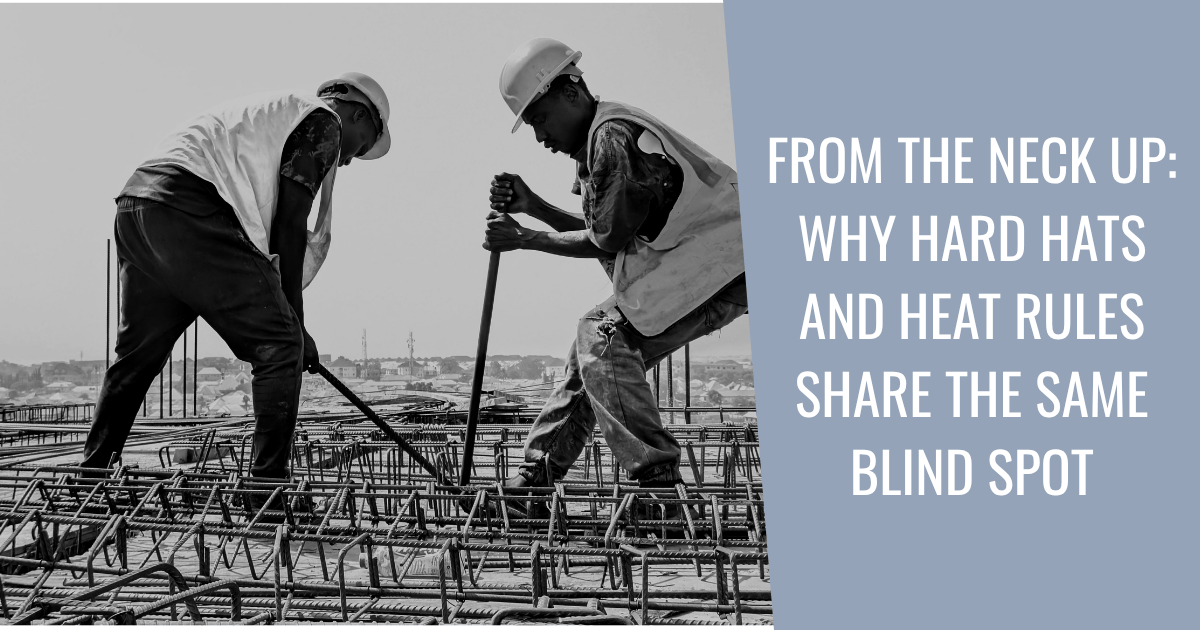
Head protection and heat safety turn out to be the same problem from the neck up. One had to protect the skull. The other has to protect the judgment inside it, and only one of the two has ever been measured on the job.
This is the part that surprises people. The guidance bodies got here years ago.
ACGIH and the World Health Organization set the benchmark that NIOSH's 2016 heat criteria document relies on: core body temperature should not exceed 38 degrees Celsius, or 100.4 Fahrenheit, during work in the heat. [12] ACGIH adds a heart rate criterion of 180 minus age, as a marker of sustained cardiovascular strain. [11] Both recommend physiological monitoring once conditions push workers past established exposure limits, and NIOSH lists physiologic monitoring as a control method rather than an optional extra. [13,14]
Read that against a typical heat illness prevention plan and the gap is obvious. The technical guidance asks you to measure the worker. The plan on the wall asks you to provide amenities and keep records. Type 2 helmets existed for years before anyone was required to consider them, and physiological monitoring is in the same position now.
OSHA's original heat National Emphasis Program expired on 8 April 2026, and two days later OSHA issued a revised version running through 2031. [8,9] An NEP is an enforcement priority list. It sets no water, rest or shade thresholds and leans on the General Duty Clause, Section 5(a)(1) of the Occupational Safety and Health Act. [15]
The proposed federal heat rule, with triggers at an 80 and 90 degree heat index, has been in process since August 2024. Its comment period closed on 30 October 2025 and no finalization date exists. [10] Only 7 states enforce their own heat standards. Every other employer in the country is working from the General Duty Clause alone.
The exposure is not waiting with it. The Atlantic Council projects that economic losses from extreme heat in the United States will roughly double to $200 billion a year by 2030, about 0.5 percent of GDP, and names construction, agriculture and manufacturing as the most exposed sectors. [16]
There is a fair reason the federal rule is hard. A helmet performs the same everywhere. Heat does not. Houston humidity, Phoenix dry heat and an unacclimatized crew in Seattle during a heat wave all demand different responses, and any single national heat index trigger will be too strict for some climates and too loose for others. A fixed number is the wrong shape for a regional problem, which may be part of why this has stalled since 2024.
Whenever the next version lands, it needs less weight on one threshold and more on requiring employers to measure the worker, capacity and cognition included, regardless of zip code. A standard built around monitoring the person travels across climates in a way a heat index number never will.
Until then, there is no reason to sit still. At Epicore this is the argument behind Connected Hydration, which measures sweat loss, sodium loss, body temperature and activity on the arm and turns water, rest and shade from an instruction into something you can audit. If you want a place to start that is not a policy rewrite, pick one crew, one hot week, and measure what actually happens to the people in it.
A standard is a floor, not a finish line. Head protection learned that. Heat is next.
Is there a federal OSHA heat standard in 2026?
No. OSHA proposed a federal heat injury and illness prevention rule in August 2024 and the comment period closed in October 2025, but no final rule has been issued. Enforcement runs through the revised Heat National Emphasis Program, effective through 2031, and the General Duty Clause. Only 7 states enforce their own heat standards.
At what temperature does OSHA require rest breaks in the heat?
There is no federal temperature threshold. The proposed rule would set triggers at an 80 and 90 degree heat index, but it is not final. State rules vary. California sets an indoor trigger at 82°F and outdoor measures at 80°F and 95°F, and Washington applies an 80°F trigger.
Which states have their own heat safety standards?
Seven states enforce their own heat standards: California, Washington, Oregon, Colorado, Minnesota, Maryland and Nevada. Coverage differs between them, with some addressing outdoor work only, some indoor work, and some agriculture specifically. Employers everywhere else operate under the General Duty Clause.
Is a written heat illness prevention plan enough to be compliant?
A written plan is usually the minimum a regulator will ask to see, and it can satisfy an inspection. It does not confirm that any individual worker stayed within safe physiological limits during a shift. ACGIH and NIOSH both recommend physiological monitoring once conditions exceed exposure limits, which is a measurement rather than a document.
What is physiological monitoring for heat stress?
Physiological monitoring means measuring the worker rather than only the environment. NIOSH lists it as a control method for conditions above the recommended exposure limit. Monitored signals can include body temperature, hydration status, heart rate and activity level, which together show whether water, rest and shade are working for that specific person.
Head protection
1. Konda S, Tiesman H, Reichard A. Fatal traumatic brain injuries in the construction industry, 2003 to 2010. American Journal of Industrial Medicine, 2016. Summarized by the CDC NIOSH Science Blog, Traumatic Brain Injuries in Construction, March 2016. blogs.cdc.gov/niosh-science-blog/2016/03/21/constructiontbi/ (primary paper: onlinelibrary.wiley.com/doi/abs/10.1002/ajim.22557)
2. Virginia Tech Helmet Lab. First independent safety helmet ratings for construction head protection, September 2025. news.vt.edu/articles/2025/09/Research-helmet-lab-construction-safety-helmet-ratings.html
3. ANSI/ISEA Z89.1, American National Standard for Industrial Head Protection. 2014 edition, reaffirmed 2019, next revision expected Q2 2026, as reported by Safety Partners. safetypartnersinc.com/2026-updates-to-ansi-isea-z89-1-2014-...-is-your-organization-prepared/
4. Engineering News-Record. Anti-Concussion Technology: The Helmet on Your Head, March 2024. enr.com/articles/58348-anti-concussion-technology-the-helmet-on-your-head
5. Clark Construction Group. Clark to require trade contractors to switch from hard hats to safety helmets, 2017. clarkconstruction.com/news/clark-require-trade-contractors-switch-hard-hats-safety-helmets
6. Construction Dive. Hard hats to helmets: how Skanska and Clark are improving workers' last line of defense, 2019. constructiondive.com/news/hard-hats-to-helmets-how-skanska-clark-are-improving-workers-last-line-o/554472/
7. US Department of Labor, OSHA. Adoption of Type II safety helmets for its own personnel, announced December 2023. osha.gov/news/newsreleases/osha-trade-release/20231211
Heat stress and physiological monitoring
8. Ogletree Deakins. OSHA's heat program to expire while heat standard stalls, 2026. ogletree.com/insights-resources/blog-posts/oshas-heat-program-to-expire-while-heat-standard-stalls/
9. Beveridge & Diamond. OSHA refines heat enforcement strategy while federal heat rule remains pending, April 2026. bdlaw.com/publications/osha-refines-heat-enforcement-strategy-while-federal-heat-rule-remains-pending/
10. OSHA. Notice of Proposed Rulemaking, Heat Injury and Illness Prevention in Outdoor and Indoor Work Settings, 30 August 2024. Post-hearing comment period closed 30 October 2025. osha.gov/heat-exposure/rulemaking
11. ACGIH. 2025 TLVs and BEIs, Thermal Stress: Heat Stress and Heat Strain, Method 4 and Table 4. acgih.org/heat-stress/
12. World Health Organization and ACGIH core body temperature guidance, 38 degrees Celsius during work in the heat, as summarized in Wearable Physiological Monitoring to Assess Heat Strain, California Department of Industrial Relations, December 2025. dir.ca.gov/chswc/Meetings/2025/12-11-2025-Item-10-White-Paper.pdf
13. NIOSH. Criteria for a Recommended Standard: Occupational Exposure to Heat and Hot Environments, 2016, Section 9.4 and Table 9.1 on physiologic monitoring methods. cdc.gov/niosh/publications/numbered/2016-106.html
14. OSHA. Heat, additional resources, referencing ACGIH and NIOSH heat stress and physiologic monitoring guidance. osha.gov/heat-exposure/resources
15. Occupational Safety and Health Act of 1970, Section 5(a)(1), the General Duty Clause, 29 U.S.C. 654. osha.gov/laws-regs/oshact/section5-duties
16. Atlantic Council. Extreme heat: the economic and social consequences for the United States, 2021. atlanticcouncil.org/in-depth-research-reports/report/extreme-heat-the-economic-and-social-consequences-for-the-united-states/
17. NIOSH. Criteria for a Recommended Standard: Occupational Exposure to Hot Environments, 1972. DHHS (NIOSH) publication 72-10269. cdc.gov/niosh/docs/72-10269/default.html
.png?width=1650&height=1275&name=Randall%20Speaking%20Posters%20(3).png)