.png?width=500&height=200&name=Untitled%20design%20(26).png)
Industrial

Years ago, at a tile plant, a slurry recipe went wrong.
Too much flocculant. The slurry bound up inside a ball mill, seized around the porcelain grinding media, and hardened into wet rock.
Somebody had to go in and get it out.
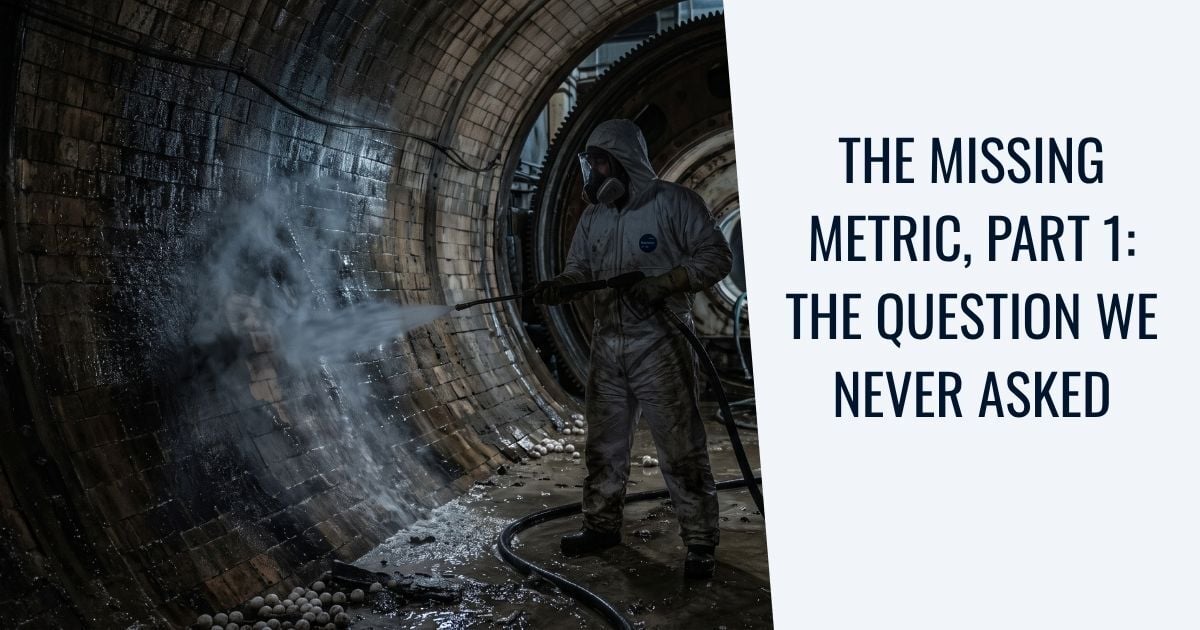
Confined space entry. Summer. Tyvek. A Hotsy putting high pressure hot water into an enclosure that was already a soup bowl, cutting hardened clay off the media piece by piece. We measured the heat index inside that vessel, and it was worse than anything outside it. Every condition we could control was working against everyone in the ball mill.
Production wanted to know when they could start back up. They asked constantly. That is not a shot at production. That is what production does, and every plant person reading this already knows that call on the radio.
So, we rotated. Constantly. Short entries, hard limits, people out before they thought they needed to come out. And we said one thing to each other for the length of that job.
That was the mentality of Donnie Pretty, our Divisional EHS Manager, and Ely Dorado, our EHS manager, ran the cadence of the job by it. I was the sponge.
I grew up on a farm and did two-a-days in high school football, so I was used to hard work in the heat. I went into that vessel myself to understand what we were asking of the crew. Farm and football did not prepare me for it. The danger and the focus it took were another level, and I came out with a new appreciation for non-routine work in that environment.
I did not know it at the time, but that job shaped how I think about production pressure set against the hard, dangerous, non-routine work it takes to fix a problem created by human error.
This story ends with nobody getting hurt.
Look at what we were doing in there.
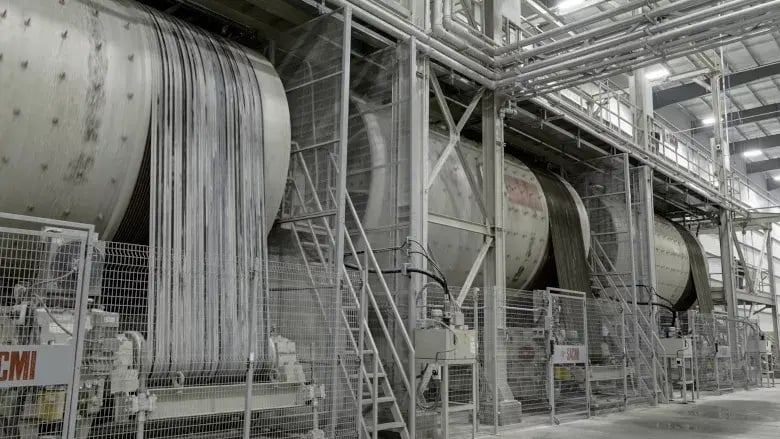 Ball mill inside a porcelean tile factory (reference image, source: https://www.stoneworld.com/)
We were worried about the worker in that vessel, that they would stop thinking clearly. We watched the heat index all day. At the time, a heat index watch was the only instrument we had besides the behavior and body language of our workers. But what kept me up was that in a Tyvek suit, in a confined space, holding a Hotsy, they would misjudge their footing, or their shovel, or how they felt, or how much longer they could stay. Everyone wanted to work quickly. We had just started production in the plant and did not need another reason to get behind.
We had no name for it. No number. No threshold. No alarm. What we had was experience, a rotation clock, and the willingness to hold the line against schedule pressure. That is what safety looked like then and, if we are honest, it is what most of it still looks like today.
The root cause went in the incident report as a recipe change. Flocculant ratio. Corrective action written. Lesson learned went out across all sites. Incident closed.
Nobody asked why the engineer made that decision on that day. What was different about that day. What he had been doing in the hours before he set the number. How long he had been in the plant. What the days leading up had been like. What the temperature was on the floor he had just walked in from. What his physiological state was when he made a decision that would put multiple workers into a hot confined space for days.
I do not know the answer. That is the point. We never asked the question.
We ran a thorough investigation of the consequence and no investigation of the decision. We managed cognition heroically inside that ball mill, by feel, with a rotation clock, behavior, and a heat stopwatch. We did not manage it at all at the operation panel out on the floor, in the same heat, where the failure started.
Read any heat incident report. Not the summary line. The narrative.
The worker did not simply get hot. They made a decision. Skipped a step. Misjudged a load, missed a lockout, walked past a hazard they would have caught at 7 a.m. and did not catch at 2 p.m.
Everything the report reaches for points at the body. The heat index. The hours. How hot they were and how long they had been in. The decision that started the chain is in there too, buried in the timeline, and almost nobody names it for what it is. [1]
Every safety professional reading this has sat in that review. You watch good people make poor decisions in the heat, and then you watch them get interviewed afterward about why they did not follow a procedure they had followed a thousand times before. Most of us who have been in that room know the honest answer was rarely about the procedure.
It was about the brain running the procedure.
Two decades on, and the science behind safety and physiological measurement instrumentation is extraordinary. Measured sweat loss. Measured sodium leaving the body. Bioelectrical impedance analysis. Core body temperature estimation. Activity level. Heart rate. Skin temperature. Physiological strain indices. Wearables on arms, in ears, on chests. Heat index trees on the site fence. Real money, real engineering, real programs. Every bit of it useful, and every bit of it aimed at the body.
And we still have no name for cognition, no number, no threshold, and no alarm. [2]
Everything downstream of that engineer's decision is measured now. The decision itself still is not.
That is the gap this series is about. Over the next 4 parts I want to make the case that cognition is the missing metric in occupational heat safety. That the science is further along, and more precise, than most of us realize. That aviation already measures how fatigue and strain degrade a pilot’s judgment, and has done for years, while we argued it could not be done on our side of the fence. [3] And that if we mean what we say about human error being a symptom rather than a cause, we are already obligated to go looking for this.
1. Adan A. Cognitive performance and dehydration. Journal of the American College of Nutrition, 2012. Even mild dehydration of 1 to 2 percent reduces attention and cognitive capacity and increases risk of workplace accidents. pubmed.ncbi.nlm.nih.gov/22855911/
2. Wittbrodt MT, Millard-Stafford M. Dehydration impairs cognitive performance: a meta-analysis. Medicine & Science in Sports & Exercise, 2018. pubmed.ncbi.nlm.nih.gov/29933347/
3. Rosa E, Lyskov E, Gronkvist M, et al. Cognitive performance, fatigue, emotional, and physiological strains in simulated long-duration flight missions. Military Psychology, 2022. An example of aviation measuring pilot cognition and physiological strain in the operational environment. pmc.ncbi.nlm.nih.gov/articles/PMC10013546/
Does heat affect cognitive performance and decision-making?
Yes. Heat, and the dehydration that comes with it, degrades attention, working memory, reaction time and judgment, often before a worker feels unwell. Research finds that even mild dehydration of 1 to 2 percent of body mass measurably reduces attention and cognitive capacity, and that environmental heat can cut information-processing capacity by around 10 percent. In safety terms, judgment tends to slip before the body shows obvious signs of heat illness. [1]
How does heat stress lead to workplace accidents?
Heat stress contributes to accidents by degrading the decisions a worker makes, not only by causing collapse. As fluid loss and body temperature rise, sustained attention, hazard recognition and impulse control decline, which is when steps get skipped, loads get misjudged and lockouts get missed. Read the narrative of most heat incident reports and a bad decision sits early in the timeline, before any recordable injury. [1,2]
What does cognition mean in occupational heat safety?
Cognition refers to the mental functions a worker relies on to stay safe: sustained attention, working memory, decision-making and the self-control to stop before an unsafe shortcut. It matters in heat safety because these functions degrade under thermal and fluid strain earlier than physical symptoms appear, and because no conventional heat program measures them. That gap is the subject of this series.
At what level of dehydration does cognitive performance decline?
Cognitive decline can begin at roughly 2 percent loss of body mass, and often before a worker feels thirsty. At that level, studies report measurable drops in attention, vigilance, reaction time, memory and decision-making. Because thirst usually activates only after a 1 to 2 percent deficit already exists, drinking to thirst tends to lag the point where judgment is already affected. [1,2]
Why don’t heat safety programs measure cognition?
Most heat programs measure the environment and the body, such as heat index, core temperature and heart rate, because those are established and straightforward to instrument, while cognition has no agreed number, threshold or alarm. The result is a blind spot: the decision that starts many heat incidents is the one variable a program does not track. Measuring the physiological drivers of cognitive strain continuously is what starts to close that gap.
.png?width=1650&height=1275&name=Randall%20Speaking%20Posters%20(3).png)